Category: The Business of Antiques

  • The Great Inkwell Experiment

    There have been several thoughts expressed to us recently, showing concern about how useful old inkwells actually are, due to evaporation rates. It occurred to us that it might be useful to have some empirical evidence either for or against (or, more likely still, both) this feeling. We have a number of inkwells in our stock, spanning a couple of centuries and any number of designs, so we are in a good position to try out a variety of types. It is our hope that this will provide everyone with a better idea of what to look for—or not—in an inkwell for regular use. (Conversely, we may even prove that inkwells are useless in modern life. Who knows?)

    proposal:
    1. Six inkwells of different design will be filled and closed with nothing more than their original lids. Included will be:

      1. glass well with a simple gravity-closing hinged lid;
      2. glass well with a silver snap-close hinged lid;
      3. metal well with glass insert and a hinged outer cover (thus with space between the insert and the cover);
      4. wooden well with glass insert and an unhinged cloth-lined wooden lid;
      5. glass writing-box bottle, with threaded brass lid;
      6. pottery ink bottle, with a new, replacement, cork;
      7. (control) plastic graduated cylinder, open;
      8. (control) modern glass ink bottle with plastic lid and synthetic lid liner (J. Herbin).
    2. Each container will be filled with distilled water. As we are comparing loss from an inkwell, rather than how different inks evaporate, the actual material won’t make a difference so long as it is consistent through all of the containers. Notably, water has several advantages:

      1. it has universally known qualities: everyone knows how water behaves in their own environment, and it will thus be easier to translate how water behaves relative to your own preferred ink, rather than, say, comparing how the J. Herbin ink in the experiment compares to your Noodler’s;
      2. it is easily available, should anyone want to duplicate this experiment;
      3. it is clean and cheap.
    3. All containers will be kept in the same enclosed space (a section of our lawyer’s bookcase.) Relative humidity will be recorded daily.
    4. Each container will be opened briefly on every seventh day. This will help to approximate the air exchange which happens during normal use. While some people may open their ink containers more often, and some less often, we felt that once-per-week is a good compromise which will reflect average use. When it comes to evaporation, this is actually a fairly important factor. A gas (in this case, the ink solvent represented by water vapour) will expand to fill all available air in a given pressure system. In plain language, fresh air is empty space for the water vapour to fill, and every time you open your ink container, you let in more fresh air. How much of a difference will this make to ink evaporation? I’m not sure, but we are trying to duplicate normal use, and normal use includes letting in fresh air every time you fill or dip your pen. And, we are only opening the containers briefly because the majority of users are filling fountain pens; the variation between dip pen and fountain pen use might be a subject for future study.
    5. Each container will be monitored by weight daily, for four weeks. (Mass is more accurate than volume, as we won’t lose any volume to the testing equipment. And it’s cleaner and easier.) We will use the metric system throughout, as it can accurately place data to multiple decimal places. This is important, as we can trace even the minimal loss of volume from tighter-fitting lids.
    6. Data will be recorded and converted to per cent loss, and the final results graphed. We will post the results on a weekly basis, as it’s more fun that way. Results will be posted to both the Fountain Pen Network and here, in our blog. Additionally, we will publish the results electronically (in PDF format) and encourage wide distribution.
  • The Fountain Pen Convert: A Cautionary Tale

    Messy
    stains
    fingers

    Leaky
    scratchy
    Bleeds-through-the-paper
    Old-fashioned

    To me, that was the fountain pen. Dip pens were worse.

    When I was a teenager, I was into calligraphy, and had a beautiful old dip pen with many nibs. Although I did enjoy using it, I found it frustrating because of the lack of quality paper. It was scratchy to write with, and the ink tended to bleed.

    I had actually bought a nice Schaeffer Connoisseur more than 15 years ago, but it was not for me. It was an anniversary gift for my husband, and I was humouring him. We had been into a beautiful store several times, and he always stopped by the fountain pen display. He had been given one years before, but (probably through moving here, there, and everywhere) had lost it. He had always wanted a replacement, and who was I to deny something that was so lovingly remembered?

    Whenever I would try to write with it, I found it really odd feeling, and awkward to use. It was big and heavy; my fingers were telling me they did not like this type of pen. But it has been wonderful to see him use it regularly. Anything that was to be written had to be done with the pen. But I felt led away to the ball points, and then the gel pens.

    In recent times, he discovered how much he liked Parker 51’s. After finding his first, he was so excited about them that he researched the history of the Parker Pen Company. He went to the library and got out the pen books that talked about how fountain pens were put together and, more importantly, how to fix them. He wanted to be able to buy something that was beautiful, not only to look at, but also to use. He wanted to encourage others to experiment with their choice of writing instrument, and come on over to the Fountain Pen Lovers side. He went online to connect with the people who were willing to share their wealth of knowledge with those who were like-minded. Through this whole time he is sharing what he is learning with the rest of us: our son, 17 years old, and two daughters 16, and 12.

    In the mean time, I’m going with the flow; you know how the conversation would sound:

    “Wow sweetie, the Parker 51 comes in how many colours?” (Some look the same to me.)

    “What do you call that thing on the end? Oh, that’s what they call the jewel?” (I thought it would look, well, like a jewel.)

    “You want to buy the book all about Parker 51s. Okay.” (How much!?)

    “The design on the cap is called what? Oh, there are more than one design and they come in gold and silver…”

    “That pen was sold for how much?!” (That’s crazy, it’s just a pen!)

    I knew I had just revealed my ignorance when my daughter (the 16-year-old) could tell me exactly what that pen was worth, and why it was more than I would have guessed. By this time, all three of my children had left the ‘normal’ pens (also known as “ink sticks”) behind, and were proud owners of fountain pens, even taking them to school.

    There was only one thing left for me to do: if you can’t ignore them, join them. It was time I caught up to the century my kids were living in (even if it was the previous one,) and I wanted&emdash;no, needed&emdash;a fountain pen too! Something is wrong when kids get in on something good before the parent.

    So I am now the proud owner of a Parker 51 (burgundy, gold-filled cap with converging lines, grey jewel.) It has a fine nib that writes beautifully. It was actually the Shoppe pen; I had tried it out and, well, what can I say? It was like semi-sweet chocolate to the tongue, the feel of fine silk to the fingers. My whole hand loved the feel of the pen and how I wrote with it. We (the royal ‘we’, that is) have discovered why we like a certain filling system better than others, what nib we like, and what colours.

    Recently my husband found a very pretty stripey Duofold. Hmm, I see where this is going. One cannot use only two pens (the Shaeffer and Parker 51) for everything. A distinguished person must have as many pens as needed: for writing on different pads, for different moods, for carrying in different bags and pockets.

    Little did I know when I fed the love of fountain pens all those years ago it would come back to me like this. We (the greater ‘we’, that is) are completely immersed, sometimes literally, in the world of fountain pens.

  • The Toronto International Pen Show

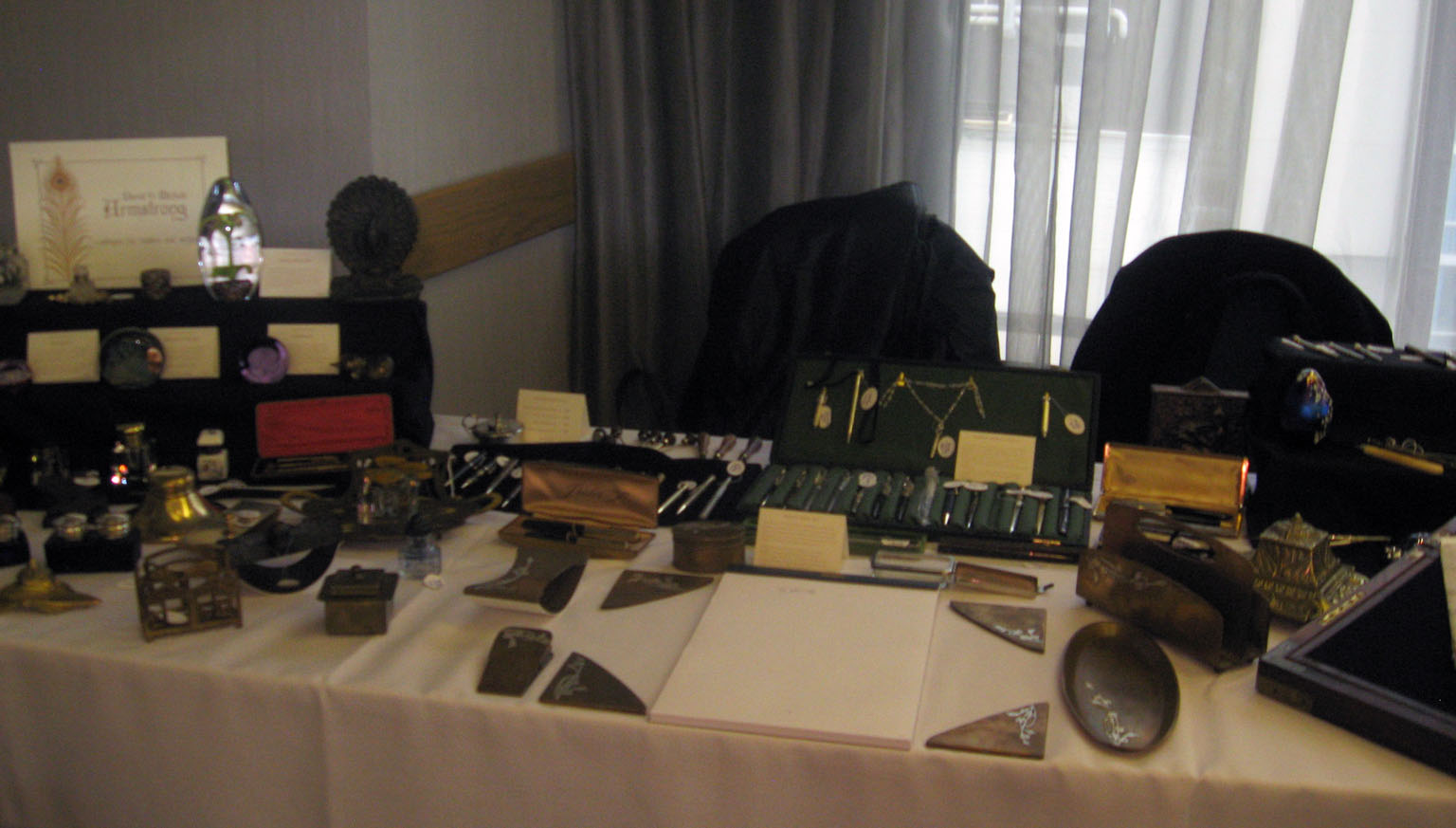
    We are happy to be attending the Toronto International Pen Show this year, for the first time. The show runs from 9:30 am to 5:00 pm, Saturday October 23, 2010, at the Hilton Toronto Airport Hotel & Suites.

    We have booked an eight foot table, and will easily fill it. Amongst our inventory will be such diverse items as:

    • fountain pens, largely Parker 51s, including an unusual late-40s double-jewelled demonstrator;
    • dip pens, including some in original boxes;
    • propelling pencils, including Mordans and a Yardolette in the original box;
    • inkwells;
    • writing boxes, including one from the late 1700s;
    • bookends;
    • paperweights, including an early O’ Keefe
    • sterling bookmarks;
    • custom pen repair tools;
    • a nearly-complete early Heintz desk set;

    As always, all items on display are clean and fully functional. Restoration is done as required, and clearly noted as such.

    We are looking forward to seeing all of you there!

    Addendum

    And see you all there, we did. The Show went well, with a steady stream of visitors from start to finish. We had a grand time meeting all sorts, including an Irish lawyer, a flex-nib-obsessed artist, and two representatives of the Toronto Steampunk Society.

    And we can now do the demonstration of our 18th century writing box in our sleep…