Category: Restoration

  • Know Any Edwardian Cuss Words?

    When you begin repairing other people’s pens, you start to see all sorts of damage; things you wouldn’t normally even imagine. Of course, then you do begin to imagine: what stories go along with what you see before you?
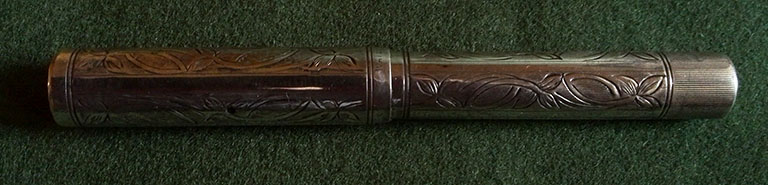
    Waterman 412½VP
    Waterman 412½VP

    This week we had one such cross our bench. And a picture is worth a thousand words.

    It is a truly lovely pen: a dainty Waterman vest pocket-sized eyedropper. Uncommonly, it is fully overlaid with silver, even the lower end. Dating to the earliest 1900s, these were all hand-made. From the water-tight section threads to the floral engraving on the barrel: true works of art. And the nibs? Fully flexible, responsive, yet strong. But then, everything is relative.

    And at some point, something happened to this pen. Something bad. This would be that point where imagination takes off. Did the owner, obviously someone with fine appreciation for pens, loan it out? Or was it simply a bad day?

    The cap went on a little crooked. And there was a slight gap—just the slightest—between the inner and outer caps. And the tip went into it.

    Now normally, that would cause one to say “hmph!”, pull the pen out, and re-cap it properly. Thus, my theory about the lending. Because that sensible reaction, the reaction of any person with an appreciation for the finest of pens, didn’t happen.

    Whoever had the pen in hand kept going. The nib was stuck between the inner and outer caps, and they just kept screwing the cap down. And the further the cap went on, the further the nib was pushed. And pulled sideways.

    Can you feel the pain?

    Waterman 412½VP - torn nib detail
    Waterman 412½VP – torn nib detail

    Now, an alloy of gold and copper (which is what this is) is a tough thing. The more it is worked, the harder it gets. And so even a thin piece of gold is quite tough, and only gets tougher.

    But we just had to keep going, didn’t we? And the more the cap was screwed tight, the tighter the nib was wedged in, until it caught. And then it started to be pulled sideways. And so much force was put into that pushing-and-pulling, that the tines were torn, quite literally, off.

    And so, our imagination dictates, some very improper Edwardian cuss words likely were released. If we are right, and this pen was loaned out at the time, there may have been another batch of improper Edwardian cuss words, unleashed shortly after it’s return.

    We could only get one of the tines out. The other remains, forever entombed in both pen and memory.

    The moral of this tale? Go gently. Any time you do something with a pen—even a simple, ordinary thing like putting on it’s cap—think about what you are doing. If there is resistance, or something doesn’t seem right, stop. Undo it. Or redo it. Or do it another time.

    If you force it, something bad could happen. Know any Edwardian cuss words?

  • Public Domain Pen Documents Now Online

    Public Domain Pen Documents Now Online

    For a look at a loud conversation about the legal and ethical issues pertaining to these documents, go to: http://fountainpenboard.com/forum/index.php?/topic/6174-public-domain-pen-documents-now-online

    Parker Pens 1929 Catalog

    It is always nice when someone decides to share. And when the thing shared is pen information, it is beyond nice: it’s a public service.

    We were browsing through our favourite host of online information, the Internet Archive and came across the fruits of some generous soul’s labour: high quality scans of vintage fountain pen & pencil documents. Catalogues and service manuals for some of the biggest names in the pen business. These are all public domain items, some in full colour, and represent a very valuable collection.

    The importance of this information cannot be understated. We can often pinpoint the age of a pen by it’s appearance in a catalogue. Or, we may be able to determine exactly which pen would have gone with which desk base. We have discovered the exact length of the neck ribbons originally supplied by Waterman. The list goes on, and that’s just the catalogues!

    The real treasure is in the service manuals. Detailed breakdowns of pens. Step-by-step instructions as to repair methods. Illustrations of tools designed & provided by the manufacturers. This information is a lifeline for old pens.

    So our thanks goes out to the kind soul who, rather than hoarding this information—or choosing to profit by selling it—chose to enrich us all. We will be monitoring archive.org closely; if this generous soul sees fit to add more documents, we will update our list here.

    The documents are posted to archive.org in groupings, which are not chronological and are named a bit oddly. We have decided to list them a little more intuitively here, so it’s easier to find what you are specifically interested in. It should be noted that the documents are available in a number of formats. Our headings here are linked to the corresponding archive.org conglomeration pages, while the individual documents listed are directly hot-linked to the pdf copies of the publications, directly on the host servers (a practice which is, incidentally, highly encouraged by the folks hosting the files).

    Parker
    Waterman

    NOTE: It has come to our attention that some of the documents listed above may have come from the online library of the Pen Collectors of America. This organization has used the library as a means of attracting new members. We appreciate that this information being freely available is a significant blow to the pca.

    This being said, there are several things to keep in mind. First, the documents hosted at archive.org are all in the public domain, which means that they are owned by no one, and are free for anyone to use. They were either never copyrighted, or their copyright has expired.

    Second, the issue of who controls information is the subject of great debate, both on the internet, and in the ‘real world’. Organizations like The Internet Archive have taken the stance that access to public domain works should not be used to enrich or empower. Large institutions such as universities, and companies like Ithaka Harbors (a non-profit company which controls jstor) take the opposing view: that access to knowledge should be controlled, for profit or purposes of accreditation.

    There have been no legal rulings on the matter, either in the usa, or in Canada (where we are). This means that simply providing the files for free is not theft, and the issue of what constitutes ownership is not relevant.

    This particular cat is out of the bag. It’s not our cat, nor was it our bag. Issues of whether these files should be available should be addressed to The Internet Archive We are going to leave this index page up, so long as the files are hosted by them.

    We also would like to express appreciation to all who provide pen information, either for profit, or not. As expressed above, more information means more interest in pens, wider & more complete knowledge of pens, and fewer pens consigned to the garbage. And no one should complain about that!

    We should also point out that the Pen Collectors of America is an excellent resource for anyone interested in pens. We encourage everyone to investigate membership there which includes, of course, access to a stunningly complete online library.

  • What Perfect Hard Rubber Should Be

    We get a lot of pens across the bench. Pens of all ages, and in all sorts of conditions. It’s always easy to remember the horror stories, and the warning examples. But when a good one comes along, a really good one, there’s nothing like it.

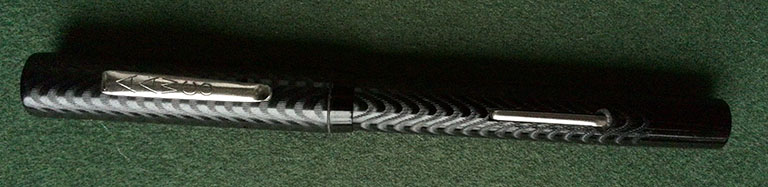
    AA Waterman
    AA Waterman

    Hard rubber is a contradictory material. It is much stronger than you would think. We’ve literally taken a hammer to a (previously damaged) barrel, as a means of stress-testing it. And had it bounce off. A half-dozen times. But soak it in water, or leave it in the sun, and it turns olive-brown. If it does crack, it is very difficult—almost impossible—to repair.

    AA Waterman
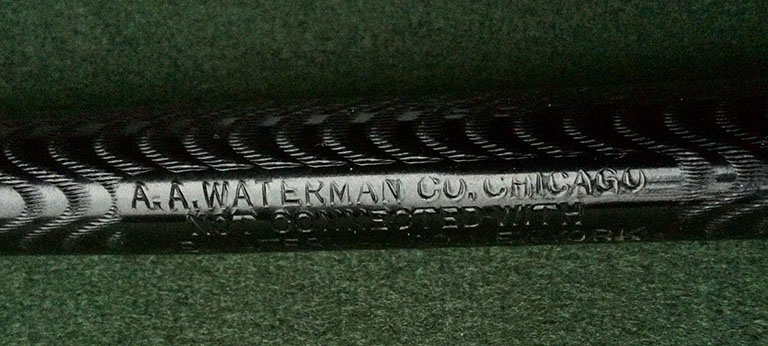
    AA Waterman – imprint detail

    But when it is cared for, it will last nearly forever. And so we come to this lovely, incredible, pen.

    The Arthur A. Waterman Company operated at the same time as the better-known L. E. Waterman. And, for all that LE were, and are, known for producing outstanding pens, AA made better ones.

    AA Waterman - nib detail
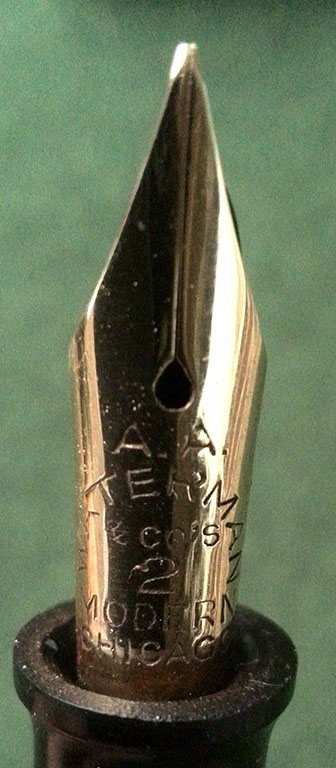
    AA Waterman – nib detail

    This is what chased hard rubber should look like: smooth, and so shiny you can see yourself in it. The chasing should be clear and crisp. Pair that with a nice flexible, responsive nib, and we have one of the best examples of one of the best pens ever made.

    And then we give it back.

  • Cracked Wood: Problem, or No Problem?

    The other day, we came across a lovely writing box. We’ve seen all kinds, and sometimes we take them on, sometimes we don’t. But this one was nearly perfect. Around two hundred years old, and made for the aristocracy: solid rosewood case, mahogany interior; mother-of-pearl inlay and pewter stringing; ebony moulding along the perimeter of the lid; the obligatory secret compartments. And very little work required. We snapped it up, and within a week it is sitting for sale at one of Toronto’s most exclusive writing equipment boutiques.

    But one thing that came up when I discussed it with Peter, the shop’s owner, was: “what about the crack in the bottom. Does that concern you?”

    I gave a quick negative reply, got distracted, and moved on. But something stuck in the back of my mind. Why, exactly, would a crack in the wood not of concern? A crack in furniture is usually a problem. A crack in a window is always a problem. You fix problems, at least to make them look better. Why, exactly, is this crack not a concern? Why did I—almost instinctively—dismiss it?

    So I sat down and sent Peter an email with a good explanation. The one I should have given him at once. The one any customer buying a museum-quality heirloom writing box, fully restored, should have. And because it addresses so well the issues of conservation vs. cosmetic repair, I thought I would share the answer with everyone.

    The short answer is: no, the crack is not a concern. Here is the long answer:

    Wood still has life in it, even after it has been cut for years: it swells and shrinks with fluctuations in humidity, and nothing will prevent this. So, the important thing is to make sure that the movement is not causing damage.

    In the case of a box like this, it was constructed with no allowance for wood movement. As a result, cracks often appear, especially in large, flat pieces like tops and bottoms which have been glued solidly along the entire edge lengths. A crack will appear along the weakest point in the grain, and follow the grain. And certain woods (mahogany, ebony) are more prone to cracking than others.

    Once the crack has appeared, and especially if it has been there for years, the movement has generally done it’s job: released pressure at extremes of humidity. From that point forward, the gap will shrink or grow only in a repetitive way, like breathing. We know where it is. And we know how it will behave.

    As a conservator, one asks: does this crack i) cause further damage? ii) impact the object’s use? And: if we take steps to repair it, will the results be worse than if we leave it?

    In the case of this particular box, the crack is relatively small (about 1/8″ wide; nothing likely to be stored in that portion of the box will fall through it), discreet (in the bottom panel, with a piece of cloth glued to the bottom), and relatively stable.

    To repair it, we would have to completely disassemble half of the box, and glue the crack shut. Because the stress point changes with relative humidity, we would be transferring the stresses to another unknown point or points, which would only become evident over time, probably as a surprise to the owner. (As a side note, when one sees horrific cracking in antiques, it is usually either shoddy construction in the first place, or bad repair work done by the ignorant.)

    Thus, the crack is a concern, but a most minor one.

    As a postscript: thinking about repair in this way is often what differentiates the conservator from the casual or amateur repairer.

    It is a source of great irony to us that many antique dealers won’t bother to clean dust and dirt from their pieces, citing the all-powerful “patina”. Yet those same dealers will happily squish Gorilla Glue into a wobbly joint or crazy glue a crack down for the sake of making something seem in better condition than it really is; efforts with more lasting negative consequences than a good dusting would ever have!

    True conservation is a combination of things:

    • First, it is thought before action: What am I doing? Why am I doing it? Is it a good idea? Have I seen the results of this treatment before, or have my colleagues?
    • Second, it is a constant dance of cost vs. benefit—not in financial terms, but in the ethical sense: Does this truly need to be done? Why? Will the piece degrade if I don’t? Will it’s use be impacted negatively if I don’t? (Remember, display is a use, but so is using an item as the original maker intended.)
    • Third, it is skill & technique. Knowledge of original materials. Knowledge of the latest practices and methods. Balance between these two. Skill with tools. And, above all, patience and an eye for detail. Some of these can grow with time and experience, others must be cultivated, or come along with the right personality.
    • And finally, it is something motivated by more than money, or even the need to search for treasures. It is motivated by a deep respect for the pieces you work with, the people who made them, used them, and will one day continue caring for them. The man (it was almost certainly a man, although part of me hopes that a few daughters hung out in the back room of the shop, too) who carefully made the hidden mitered-dovetails that no one would ever see; the great Lord who carried his correspondence—in his trusty writing box—in the carriage from the town house to the country house; two hundred years of caretakers, who kept a box like this inside, clean and dry. If they could see the way a good conservator approaches the work, it should be worthy of a good nod of approval.

    It is important work, this. It is a rare work. But it is good, and it needs to go on.

  • On Lime Juice

    Oxidation is often our enemy. When oxygen contacts metals, it reacts with the surface atoms to form what is known scientifically as an oxide, but more commonly as rust, or tarnish. While in the case of some metals—such as copper—oxidation can result in a beautiful green colour, in the case of silver or iron it case cause damage.

    Especially in the case of iron or steel, rust causes pitting and weakening and can be very difficult to remove. We often run in to similar problems in the internal mechanisms of mechanical pencils, which are often made of brass. A build-up of oxidation can cause parts to seize together or become gummy.

    So, oxidation can be our enemy. Happily, the solution is simple, safe, and cheap: lime juice.

    Citric acid has long been known as a very effective chellation agent. In simple terms, this means that it literally removes the top layer of metal atoms; since the top layer of atoms is bound up with oxygen, as tarnish, this is a good thing.

    How to Use Lime Juice to Remove Rust and Tarnish

    • Pour together in a glass bowl: 1 part lime juice, 3 parts vinegar;
    • Microwave until warm (this speeds up the reaction time);
    • Submerge the tarnished item in the solution, and leave for about an hour (or as long as overnight);
    • Wash off the item with warm, soapy water, using a soft brush. A dark, almost sludgy layer will come off, leaving a dull layer of metal. Polish if desired.

    Using this method even stubborn and pitted steel and iron will come out clean, including the fiddly detail in Victorian cast iron. And while this method does remove metal, the amount is very negligible, most of which was beyond recovery, bound up with oxide atoms. (One word of caution: some gold plating can be very thin, especially if produced in the last 50 years or so. You might want to use another method on items like this.)

    An additional benefit is that this solution, although acidic (with a pH of about 3) is safe for plastics and wood, and won’t compromise many adhesives (cyanoacrylates, like “crazy glue” being a notable exception).

    As an aside, it’s quite amazing how much oxidation just a bit of this solution can remove. Even if it looks grey and sludgy, there is still quite a bit of reaction-power left in it.

    A Note on ‘Patina’

    Does this method affect the patina of a metal item? Yes, and no, depending on your definition of the word. Courtesy of the Oxford English Dictionary:

    Patina
    a. A thin coating or layer; spec. an incrustation on the surface of metal or stone, usually as a result of an extended period of weathering or burial; a green or bluish-green film produced naturally or artificially by oxidation on the surface of bronze and copper, consisting mainly of basic copper sulphate (cf. verdigris n.).
    Heintz Bowl

    Factory-produced patina
    from the early 20th C.
    Heintz Vase

    And in two colours!

    In this case, a resounding yes! Destructive oxidation will be gone. So will the brown colour that develops over a few weeks or months on copper, brass, or bronze.

    One notable warning: in some cases (particularly in “Arts & Crafts” metal pieces) a specific chemical finishing process was used in their manufacture, resulting in a highly-sought colouration. This method will remove that finish. This is the “patina” most misunderstood by antique dealers, many of whom use it’s legend as an excuse not to spend time cleaning anything. A factory patina should not be confused with destructive oxidation, like rust. And, to our knowledge, few items made of silver were ever intended by their makers to remain blackened by tarnish.

    b. A gloss or sheen; spec. that on wooden furniture produced by age and polishing.
    c. fig. An acquired accretion of an abstract quality; a superficial impression or appearance.

    In these cases: the small signs of use that, over time, make something beautifully imperfect; the ancient ‘feel’ of an antique? No. You are cleaning it, thoroughly. But small dents and surface scratches will remain.

    Soaking metal in acid as a means of cleaning it is a serious step, and should only be done according to the rules of restoration and conservation: when needed to halt or repair damage. But when you need to do it, lime juice is fast, cheap, easy, and safe. The very definition of the most effective tools we have.

  • Holidays

    We are on holidays for the week of May 18-25, 2013. Our email response time may be delayed, and orders will be filled after our return.