Category: Blog

  • Know Any Edwardian Cuss Words?

    When you begin repairing other people’s pens, you start to see all sorts of damage; things you wouldn’t normally even imagine. Of course, then you do begin to imagine: what stories go along with what you see before you?
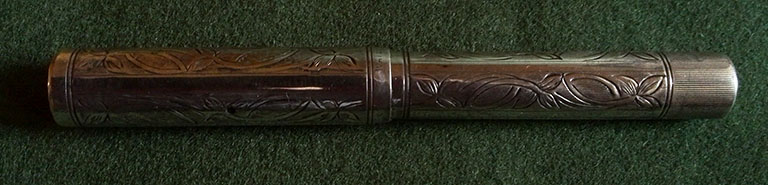
    Waterman 412½VP
    Waterman 412½VP

    This week we had one such cross our bench. And a picture is worth a thousand words.

    It is a truly lovely pen: a dainty Waterman vest pocket-sized eyedropper. Uncommonly, it is fully overlaid with silver, even the lower end. Dating to the earliest 1900s, these were all hand-made. From the water-tight section threads to the floral engraving on the barrel: true works of art. And the nibs? Fully flexible, responsive, yet strong. But then, everything is relative.

    And at some point, something happened to this pen. Something bad. This would be that point where imagination takes off. Did the owner, obviously someone with fine appreciation for pens, loan it out? Or was it simply a bad day?

    The cap went on a little crooked. And there was a slight gap—just the slightest—between the inner and outer caps. And the tip went into it.

    Now normally, that would cause one to say “hmph!”, pull the pen out, and re-cap it properly. Thus, my theory about the lending. Because that sensible reaction, the reaction of any person with an appreciation for the finest of pens, didn’t happen.

    Whoever had the pen in hand kept going. The nib was stuck between the inner and outer caps, and they just kept screwing the cap down. And the further the cap went on, the further the nib was pushed. And pulled sideways.

    Can you feel the pain?

    Waterman 412½VP - torn nib detail
    Waterman 412½VP – torn nib detail

    Now, an alloy of gold and copper (which is what this is) is a tough thing. The more it is worked, the harder it gets. And so even a thin piece of gold is quite tough, and only gets tougher.

    But we just had to keep going, didn’t we? And the more the cap was screwed tight, the tighter the nib was wedged in, until it caught. And then it started to be pulled sideways. And so much force was put into that pushing-and-pulling, that the tines were torn, quite literally, off.

    And so, our imagination dictates, some very improper Edwardian cuss words likely were released. If we are right, and this pen was loaned out at the time, there may have been another batch of improper Edwardian cuss words, unleashed shortly after it’s return.

    We could only get one of the tines out. The other remains, forever entombed in both pen and memory.

    The moral of this tale? Go gently. Any time you do something with a pen—even a simple, ordinary thing like putting on it’s cap—think about what you are doing. If there is resistance, or something doesn’t seem right, stop. Undo it. Or redo it. Or do it another time.

    If you force it, something bad could happen. Know any Edwardian cuss words?

  • Public Domain Pen Documents Now Online

    Public Domain Pen Documents Now Online

    For a look at a loud conversation about the legal and ethical issues pertaining to these documents, go to: http://fountainpenboard.com/forum/index.php?/topic/6174-public-domain-pen-documents-now-online

    Parker Pens 1929 Catalog

    It is always nice when someone decides to share. And when the thing shared is pen information, it is beyond nice: it’s a public service.

    We were browsing through our favourite host of online information, the Internet Archive and came across the fruits of some generous soul’s labour: high quality scans of vintage fountain pen & pencil documents. Catalogues and service manuals for some of the biggest names in the pen business. These are all public domain items, some in full colour, and represent a very valuable collection.

    The importance of this information cannot be understated. We can often pinpoint the age of a pen by it’s appearance in a catalogue. Or, we may be able to determine exactly which pen would have gone with which desk base. We have discovered the exact length of the neck ribbons originally supplied by Waterman. The list goes on, and that’s just the catalogues!

    The real treasure is in the service manuals. Detailed breakdowns of pens. Step-by-step instructions as to repair methods. Illustrations of tools designed & provided by the manufacturers. This information is a lifeline for old pens.

    So our thanks goes out to the kind soul who, rather than hoarding this information—or choosing to profit by selling it—chose to enrich us all. We will be monitoring archive.org closely; if this generous soul sees fit to add more documents, we will update our list here.

    The documents are posted to archive.org in groupings, which are not chronological and are named a bit oddly. We have decided to list them a little more intuitively here, so it’s easier to find what you are specifically interested in. It should be noted that the documents are available in a number of formats. Our headings here are linked to the corresponding archive.org conglomeration pages, while the individual documents listed are directly hot-linked to the pdf copies of the publications, directly on the host servers (a practice which is, incidentally, highly encouraged by the folks hosting the files).

    Parker
    Waterman

    NOTE: It has come to our attention that some of the documents listed above may have come from the online library of the Pen Collectors of America. This organization has used the library as a means of attracting new members. We appreciate that this information being freely available is a significant blow to the pca.

    This being said, there are several things to keep in mind. First, the documents hosted at archive.org are all in the public domain, which means that they are owned by no one, and are free for anyone to use. They were either never copyrighted, or their copyright has expired.

    Second, the issue of who controls information is the subject of great debate, both on the internet, and in the ‘real world’. Organizations like The Internet Archive have taken the stance that access to public domain works should not be used to enrich or empower. Large institutions such as universities, and companies like Ithaka Harbors (a non-profit company which controls jstor) take the opposing view: that access to knowledge should be controlled, for profit or purposes of accreditation.

    There have been no legal rulings on the matter, either in the usa, or in Canada (where we are). This means that simply providing the files for free is not theft, and the issue of what constitutes ownership is not relevant.

    This particular cat is out of the bag. It’s not our cat, nor was it our bag. Issues of whether these files should be available should be addressed to The Internet Archive We are going to leave this index page up, so long as the files are hosted by them.

    We also would like to express appreciation to all who provide pen information, either for profit, or not. As expressed above, more information means more interest in pens, wider & more complete knowledge of pens, and fewer pens consigned to the garbage. And no one should complain about that!

    We should also point out that the Pen Collectors of America is an excellent resource for anyone interested in pens. We encourage everyone to investigate membership there which includes, of course, access to a stunningly complete online library.

  • What Perfect Hard Rubber Should Be

    We get a lot of pens across the bench. Pens of all ages, and in all sorts of conditions. It’s always easy to remember the horror stories, and the warning examples. But when a good one comes along, a really good one, there’s nothing like it.

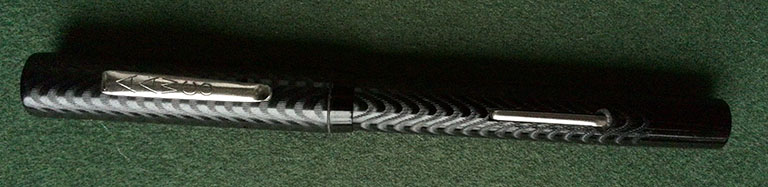
    AA Waterman
    AA Waterman

    Hard rubber is a contradictory material. It is much stronger than you would think. We’ve literally taken a hammer to a (previously damaged) barrel, as a means of stress-testing it. And had it bounce off. A half-dozen times. But soak it in water, or leave it in the sun, and it turns olive-brown. If it does crack, it is very difficult—almost impossible—to repair.

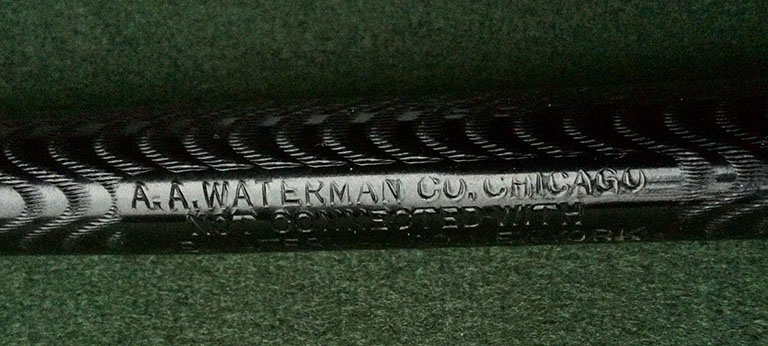
    AA Waterman
    AA Waterman – imprint detail

    But when it is cared for, it will last nearly forever. And so we come to this lovely, incredible, pen.

    The Arthur A. Waterman Company operated at the same time as the better-known L. E. Waterman. And, for all that LE were, and are, known for producing outstanding pens, AA made better ones.

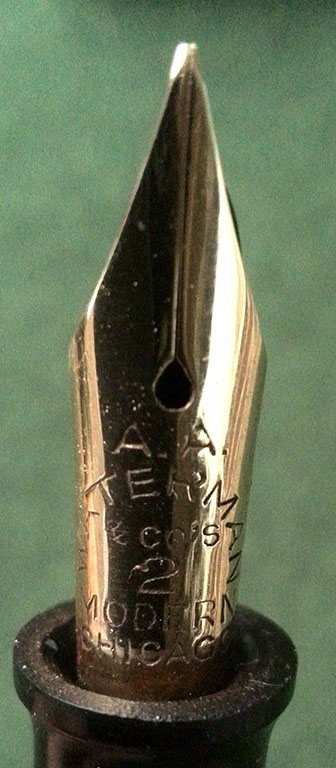
    AA Waterman - nib detail
    AA Waterman – nib detail

    This is what chased hard rubber should look like: smooth, and so shiny you can see yourself in it. The chasing should be clear and crisp. Pair that with a nice flexible, responsive nib, and we have one of the best examples of one of the best pens ever made.

    And then we give it back.

  • Basics: Categories of Vintage Mechanical Pencils

    The world of mechanical pencils isn’t what it once was.

    If you visit a stationery or office supply store today, you will generally find two sorts of mechanical pencils: click, and clutch. A click pencil is the one with skinny little leads, which are advanced with a “click”, by pushing the end button. Clutch pencils are usually found in the drafting tools, and hold a hefty 2 mm lead. When you push on the end, three claws push out of the end, releasing the lead.

    But once upon a time, there were more. And they are there still, waiting to be discovered.

    However, there can be some confusion as to how to operate vintage mechanical pencils; how to fill them; how to care for them. Hopefully this article will help to clear up some of the confusion.

    Although mechanical pencils became popular, there was always a place for the simple clutch pencil, essentially unchanged for two hundred years. Much to the irritation of those in love with them, they will be ignored in this article, and we focus on their more complicated cousins, the true mechanical pencils.

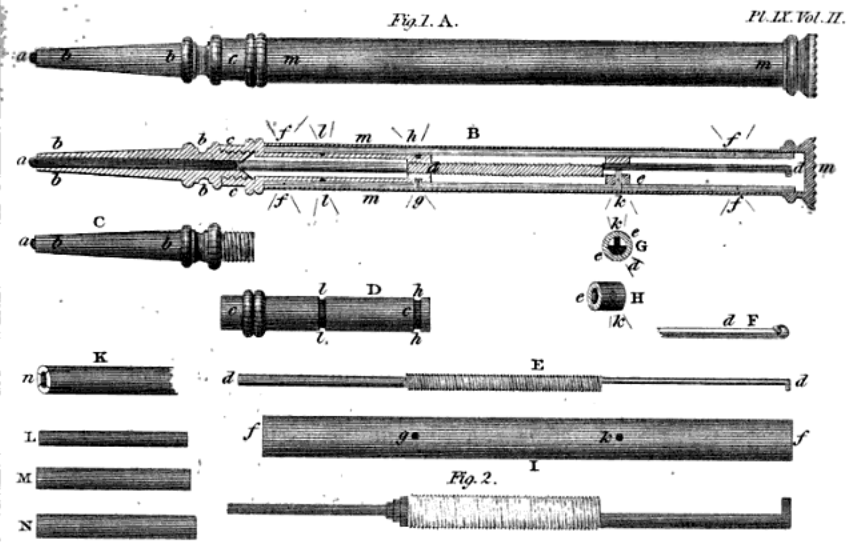
    Beginnings: Sampson Mordan
    1822 Mordan Patent Drawing
    1822 Mordan Patent Drawing

    In the early 1800s, a silversmith named Sampson Mordan filed a patent for what would become the basis of almost all mechanical pencils: the helical drive. This began a renaissance in pencils, and thousands were produced, modified, and adapted, throughout the world.

    Type One: Propelling Pencil

    While all mechanical pencils push the lead out&#0151in fact, it can be argued that this is their very character—for some, that is their limit.

    The earliest pencils, such as the Mordans, are simple, propelling pencils. The lead is manually pushed down a tube of matching diameter, and is friction-fit. A small rod inside pushes the lead forward, as needed, usually with a twist action mechanism. When done writing, the user twists the mechanism in reverse, and manually pushes the lead back down into it’s socket.

    Fancy Propelling Pencil
    Fancy Propelling Pencil

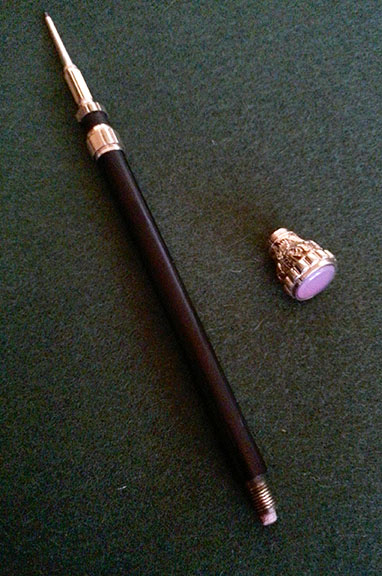
    Some of these pencils are simple, some are fancy. With lead-storage compartments, erasers hidden inside the finial, or even finial-mounted engraved jewels, there was something for every income level. But until the early 20th century, they were generally all just plain, propelling pencils.

    Type Two: Propel-Repel

    At some point, someone became understandably irritated with having to push down the lead in their pencil. “Wouldn’t it be nice,” we imagine them saying over dinner, “ if the darned thing would just go back in on it’s own?” And so the propel-repel pencil was born.

    Where the previous incarnation of the pencil had the lead freely sliding in and out of a closely-fitted tube, a new innovation approached the problem a little differently. The end of the lead firmly fitted into a socket, and the socket—attached to a shuttle—moved up and down the length of the barrel.

    This was an excellent and convenient solution, and users around the world sat at their desks, twisting the mechanism back-and-forth, watching the lead go in-and-out, solidly held in place.

    Until the lead broke off, right at the socket. Then the only solution was to get out a very small drill bit, and ream out the socket, scattering graphite dust everywhere. Obviously more innovation was needed.

    Type Three: Propel-Repel-Expel
    Yard-o-led Mechanism Detail
    The pinnacle of pencil design!

    In the 1930s, a true innovation took place. Rather than simply wedging the lead into a socket, a propelling rod was placed inside the socket; one which travels only far enough to push remnants of the lead out of the socket, doing so only when the mechanism is at the furthest point of travel along the barrel.

    This design was truly revolutionary, and is still in use in fine mechanical pencils today. It became eloquently known as the propel-repel-expel pencil.

    These three main categories—propel, propel-repel, and propel-repel-expel—are not comprehensive. You may come across variations, and combinations, of two or all three varieties. But keeping these basic design types in mind may prevent you from trying to, for example, pull out a propelling rod, thinking that it is a piece of lead stuck inside. Or it may help you to recognize that more is wrong with that Vacumatic pencil than is first apparent.

    No matter the mechanism with which your pencil is equipped, the action should be smooth and easily worked. The lead shouldn’t fall out in use, and it should be back in the barrel when you are done writing. It should be reliable and clean.

    Not bad, for a two-hundred-year-old design.

  • About Descriptions

    When it comes to describing antique and vintage items, there are no standards. This is both a blessing, and a curse. For example: the term wet noodle. This term is used by some to describe a pen which writes with a high ink flow, and whose nib is extremely flexible. But there are some real difficulties with using terms like this, because it is so subjective.

    Wet, compared to what? Flexible compared to what? Someone who has handled dozens of pens will have a completely different definition in their mind than someone who has handled hundreds, or thousands. And someone with a specific range of interests will often simply not pay attention to pens outside their chosen range. In contrast, a repair technician has no choice as to the pens they handle, and will thus have a wider range of experience. This may be vastly different from someone to whom they are speaking on the subject.

    So, to avoid the problem of making subjective assessments, we don’t. We have a simple standard: we only make objective assessments. We get out the calipers, and the rulers, and we measure. Often to the tenth of a millimeter.

    For example, when describing a nib, we might say:

    Nib
    stamped “parker | lucky [lazy S] curve | pen ”, fine width (0.4 mm). Flexible, to about 1.5 mm.

    This description means:

    Parker Duofold - "Lazy S" Nib
    Parker Duofold – “Lazy S” Nib
    • that the nib has the words in quotation marks stamped into it, in three tiers (the vertical bars indicate a new line, and the words in square brackets indicate our description of something graphic in nature; this is a convention used in bibliography, when describing things that have been printed).
    • that we have actually measured the width of the tipping at rest, and it is exactly 0.4 mm wide.
    • that we have flexed the nib to it’s safest pressure point, and measured it at 1.5 mm. Does this mean it can’t be flexed further? No. But some folks who make claims of ‘super’ nib flexibility flex their nibs past the point of safety. We have had to repair enough nibs which have been sprung out of shape that we know when to stop. So if we say that this “lazy S” nib can only be safely flexed to 1.5 mm, take it as our professional advice not to exceed that threshold, others’ opinions about these nibs notwithstanding.
    • that it has a fairly high ink flow. Any pen which writes when flexed to 1.5 mm has to have a high ink flow, or it will not be able to provide enough ink for a line that wide. If it was a dry writer, we would either adjust the pen itself, or adjust our description to downgrade the maximum thickness of writing line. Some things go without saying, and this is one of them: if it doesn’t write properly, it’s not listed on our site.

    Is this nib a “wet noodle”? Some might say so others might not. We don’t use the term. It’s just not accurate.

    This principle follows in a number of areas. Is it an “over-sized” pen? Is that box a piece of “treenware”? How is the barrel clarity? Is it a “BBB”? All subjective questions, and guaranteed to get a seller in trouble.

    So, if you have a question, read the description carefully; both what’s in it, and what is left out. If a photo is needed to clarify, we have probably provided it. If not, we would be happy to.

  • Site Overhaul

    Over the next little while we will be doing some site maintenance (actually, a full thematic overhaul). So, if things look a bit strange, don’t panic.

    Update

    We’re happy to say that much of the behind-the-scenes is done with our new look. We will be updating the shoppe over the next little while, so stay tuned!